

The most critical component in rotorcraft. And the heart of everything we do.
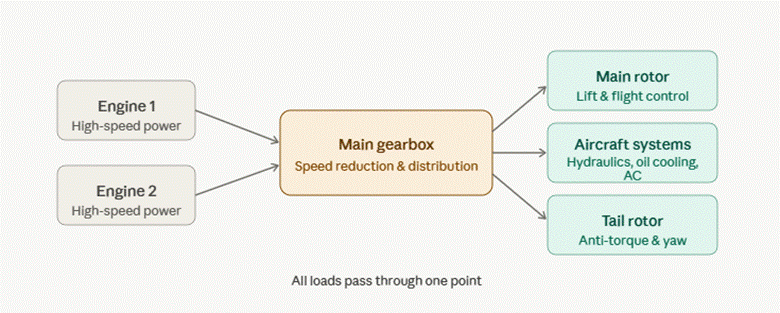
Inside every helicopter, at the very top of the machine, sits one component that everything else depends on: the main gearbox. It is the mechanical heart of rotorcraft flight — receiving power from the engine or engines, reducing it to the precise speed needed to turn the main rotor blades, and distributing it to every system that keeps the aircraft alive.
Without it, there is no lift. Without it, there is no flight. And unlike almost any other failure on a helicopter, a main gearbox failure is not recoverable.
Why the MGB Is in a Category of Its Own
Pilots train for engine failures. When an engine quits, a skilled helicopter pilot can autorotate — converting rotor inertia into a controlled descent and landing. It is demanding, but it is survivable.
A main gearbox failure is different. There is no procedure for it. There is no backup. If the MGB fails in flight, the rotor stops doing its job — and the outcome is catastrophic.
This is what sets the main gearbox apart from every other component in the drivetrain. It is the one point of mechanical truth in rotorcraft flight. Not simply important — mission critical.
What a Main Gearbox Actually Does
The MGB carries out several critical functions simultaneously:
Speed Reduction
Turbine engines spin at extraordinary speeds — far beyond what any rotor blade could safely sustain. The gearbox bridges that enormous gap through a series of precision gear stages, each stepping the speed down while stepping torque up, delivering exactly the rotational speed the main rotor requires for controlled flight.
Power Distribution
In multi-engine aircraft, the MGB combines and balances power from multiple engines into a single output. It also drives:
- The main rotor drive system
- The tail rotor drive system
- Hydraulic systems
- Oil cooling and lubrication systems
- Accessory drives and support systems
Load Management
The MGB must handle not just the raw torque of the engines, but the constantly shifting aerodynamic loads transmitted back through the rotor head. It absorbs vibration, manages axial and radial forces, and does so continuously, across thousands of flight hours.
Structural Support
In most designs, the rotor mast runs directly through or is integrated with the MGB. This means the gearbox is also a primary structural member of the aircraft. The entire rotor system, and every load it generates, flows through it.
Engineering at the Edge of What’s Possible
Designing a main gearbox requires some of the most advanced engineering in aviation. Engineers must balance competing demands simultaneously:
- Extreme torque loads and structural strength
- Heat management and lubrication performance
- Weight reduction without compromising integrity
- Vibration and noise control
- Redundancy, fault tolerance, and dry-run capability
- Certification and airworthiness compliance
The tolerances involved are extraordinary. Gear teeth are machined to micron-level precision. The entire assembly is balanced to reduce vibration that would otherwise transmit directly into the airframe. Many designs include dry-run capability — the ability to continue operating for a defined period after complete oil loss, giving a crew time to land.
Every gear tooth, bearing surface, lubrication channel, and housing structure must perform flawlessly under enormous stress. The result is a system built for precision, endurance, and absolute reliability.
The MGB and the eVTOL Era
The rise of electric vertical takeoff and landing (eVTOL) aircraft and advanced air mobility (AAM) is reshaping how the industry thinks about drivetrain design — and the role of the gearbox within it.
Many eVTOL architectures use distributed electric propulsion — multiple smaller electric motors driving individual rotors or propellers directly, reducing or eliminating the need for a central mechanical gearbox. This spreads risk across many motors, any one of which can fail without causing catastrophic loss of lift.
But the story doesn’t end there. Higher-powered eVTOL designs, hybrid-electric systems, and tilt-rotor configurations still require mechanical power transmission. The physics of high-torque power transfer haven’t changed. In these applications, the MGB remains as relevant as ever, adapted for new powerplants and new duty cycles.
The broader rotorcraft world — military helicopters, oil and gas operations, search and rescue, medevac, offshore transport — continues to rely on conventional gearbox architectures that will remain in service for decades.
The gearbox isn’t going away. It’s evolving.
Why We’re Called MainGearbox
We chose this name deliberately.
Because every industry has a center point. In rotorcraft, it is the gearbox. In the vertical flight industry, it is the network of people, companies, engineers, pilots, operators, maintainers, innovators, and leaders driving the future forward.
MainGearbox is that connection point. It is where the industry meets. Where professionals connect. Where innovation turns into action. Where rotorcraft, eVTOL, and advanced air mobility come together.
Just like the mechanical main gearbox connects the aircraft, MainGearbox connects the vertical flight community.
More Than a Name
MainGearbox is built on the same principles that define the component itself:
- Reliability — built to perform, every time
- Strength — engineered for the highest demands
- Precision — no tolerance for approximation
- Connection — where the industry comes together
- Performance — advancing the state of the art
- Trust — earned through consistency and expertise
These values drive aviation. And they drive us. Because in vertical flight, everything depends on what keeps the system turning.
Welcome to the Center of Vertical Flight
Whether you’re a pilot, mechanic, engineer, OEM, supplier, operator, investor, startup founder, or aviation enthusiast — this is where the conversation begins.
Where Vertical Flight Connects.
